EX-99.2
Published on

O c t o b e r 1 9 , 2 0 2 1 C e r n o st i c s A c q u i s i t i o n
D i s c l a i m e rs F O R W A R D - L O O K I N G S T A T E M E N T S The information in this presentation contains forward-looking statements and information within the meaning of Section 27A of the Securities Act of 1933, as amended, and Section 21E of the Securities Exchange Act of 1934, as amended, which are subject to the “safe harbor” created by those sections. These forward-looking statements include, but are not limited to, statements concerning the expected timing and actual closing of the transaction, Castle’s estimated U.S. TAM following the consummation of the transaction, Castle’s ability to integrate the TissueCypher Barrett’s Esophagus Assay into its commercial offerings, the ability of the Cernostics and Castle teams to complement each other and to accelerate our impact on patient care and drive value creation for shareholders, the ability of the TissueCypher Barrett’s Esophagus Assay to predict future development of HGD and/or esophageal cancer in patients with BE, objectively and accurately predict progression from BE to HGD or EAC, improve the prevention of esophageal cancer and help physicians and patients make more informed management decisions based on the unique biology of individual patients’ esophageal biopsies. The words “anticipates,” “believes,” “estimates,” “expects,” “intends,” “may,” “plans,” “projects,” “will,” “would” and similar expressions are intended to identify forward-looking statements, although not all forward-looking statements contain these identifying words. We may not actually achieve the plans, intentions, or expectations disclosed in our forward-looking statements and you should not place undue reliance on our forward-looking statements. Actual results or events could differ materially from the plans, intentions and expectations disclosed in the forward-looking statements that we make. These forward-looking statements involve risks and uncertainties that could cause our actual results to differ materially from those in the forward-looking statements, including, without limitation, the conditions to closing may not be satisfied and the transaction may be delayed or not close at all, the effects of the COVID-19 pandemic on our business and our efforts to address its impact on our business, the TissueCypher Barrett’s Esophagus Assay’s ability to provide the aforementioned benefits to patients, physicians and Castle and the risks set forth in our Quarterly Report on Form 10-Q for the quarter June 30, 2021, and in our other filings with the SEC. The forward-looking statements are applicable only as of the date on which they are made, and we do not assume any obligation to update any forward-looking statements, except as may be required by law. 2
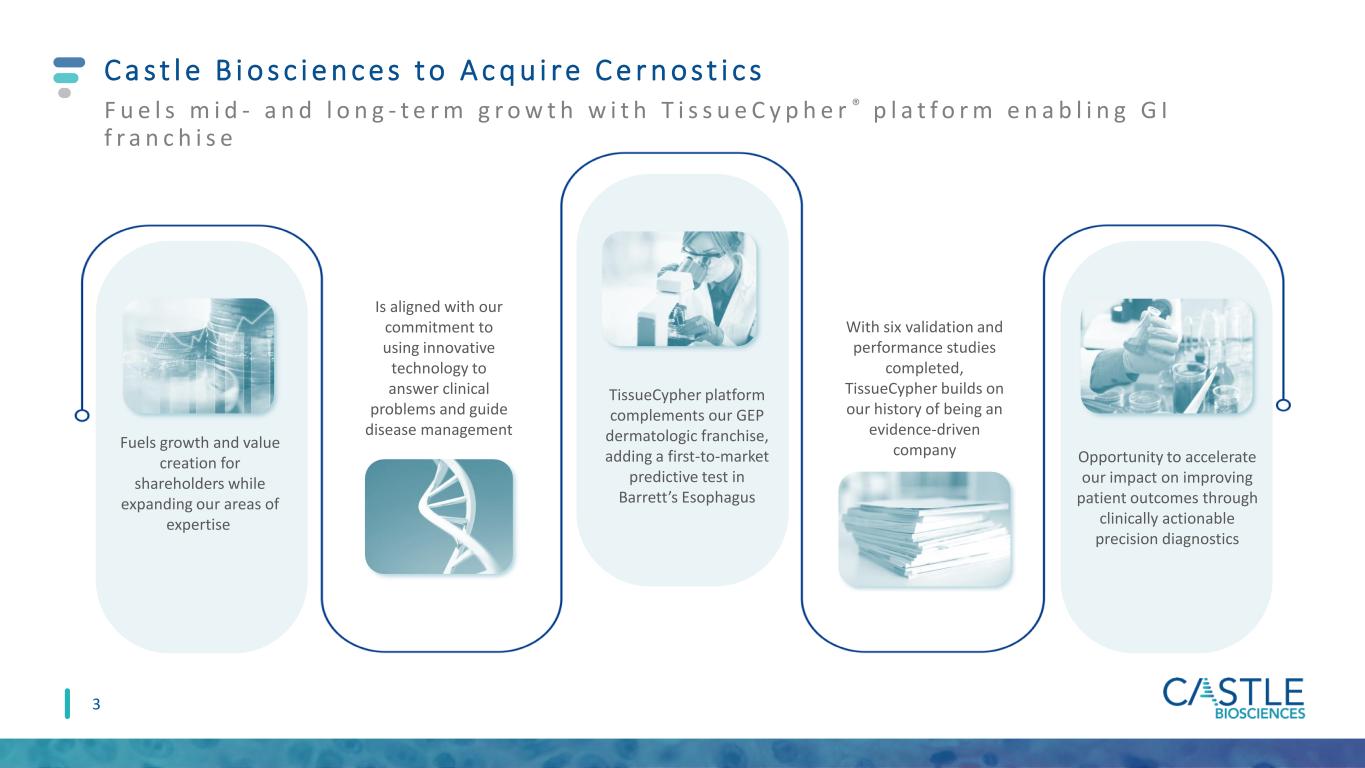
Is aligned with our commitment to using innovative technology to answer clinical problems and guide disease management TissueCypher platform complements our GEP dermatologic franchise, adding a first-to-market predictive test in Barrett’s Esophagus Fuels growth and value creation for shareholders while expanding our areas of expertise 3 Opportunity to accelerate our impact on improving patient outcomes through clinically actionable precision diagnostics C a s t l e B i o s c i e n c e s t o A c q u i re C e r n o s t i c s F u e l s m i d - a n d l o n g - t e r m g r o w t h w i t h T i s s u e C y p h e r ® p l a t f o r m e n a b l i n g G I f r a n c h i s e With six validation and performance studies completed, TissueCypher builds on our history of being an evidence-driven company
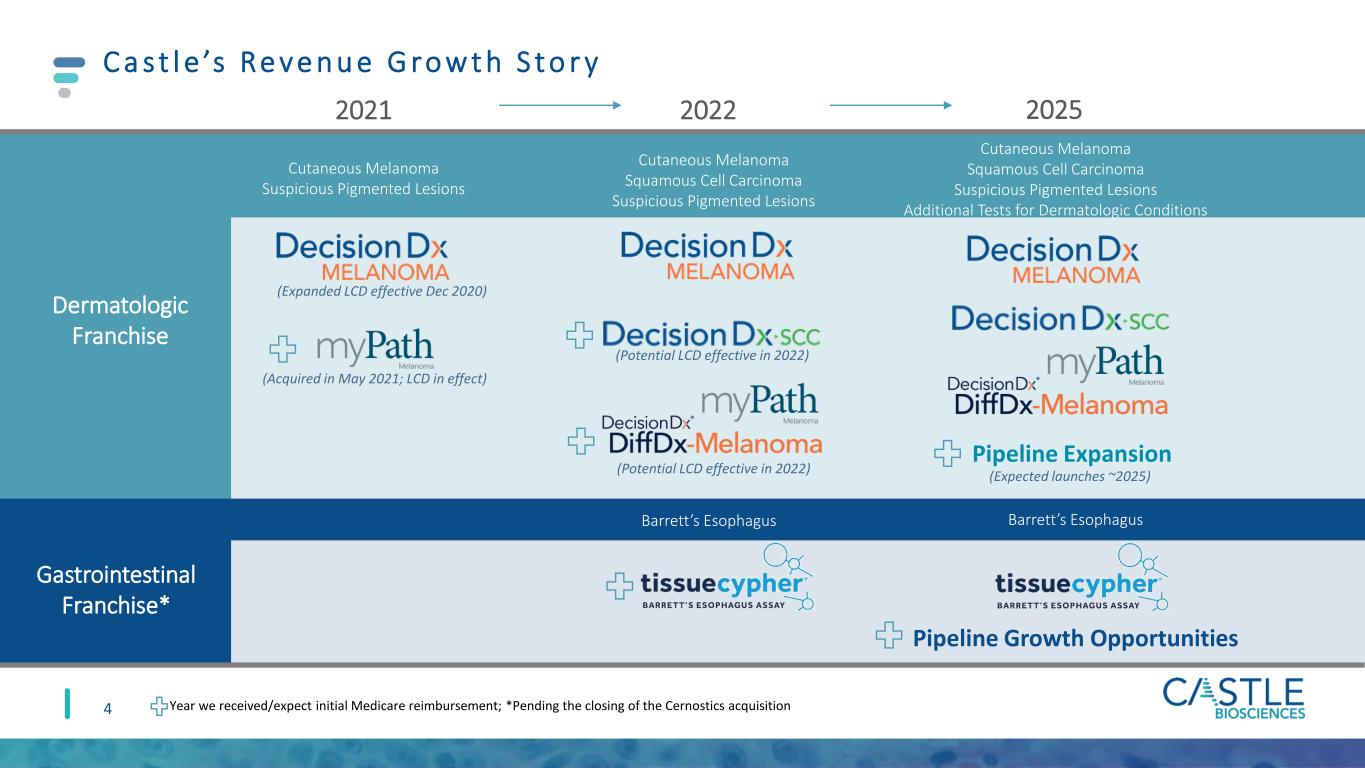
2022 C a s t l e ’s Re v e n u e G ro w t h S t o r y 4 2021 (Expanded LCD effective Dec 2020) (Potential LCD effective in 2022) (Acquired in May 2021; LCD in effect) (Potential LCD effective in 2022) Pipeline Expansion 2025 (Expected launches ~2025) Cutaneous Melanoma Squamous Cell Carcinoma Suspicious Pigmented Lesions Cutaneous Melanoma Suspicious Pigmented Lesions Cutaneous Melanoma Squamous Cell Carcinoma Suspicious Pigmented Lesions Additional Tests for Dermatologic Conditions Barrett’s Esophagus Barrett’s Esophagus Dermatologic Franchise Gastrointestinal Franchise* Pipeline Growth Opportunities Year we received/expect initial Medicare reimbursement; *Pending the closing of the Cernostics acquisition
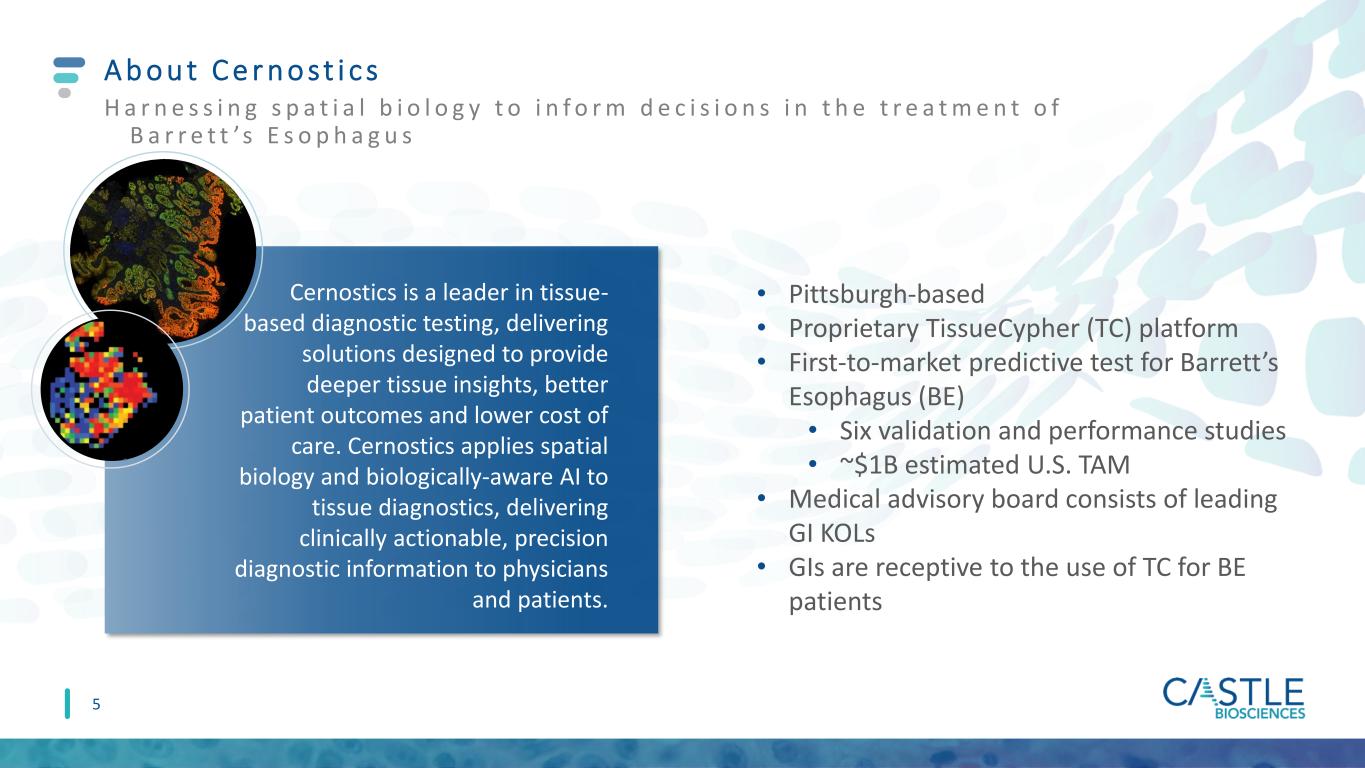
5 A b o u t C e r n o s t i c s H a r n e s s i n g s p a t i a l b i o l o g y t o i n f o r m d e c i s i o n s i n t h e t r e a t m e n t o f B a r r e t t ’s E s o p h a g u s • Pittsburgh-based • Proprietary TissueCypher (TC) platform • First-to-market predictive test for Barrett’s Esophagus (BE) • Six validation and performance studies • ~$1B estimated U.S. TAM • Medical advisory board consists of leading GI KOLs • GIs are receptive to the use of TC for BE patients Cernostics is a leader in tissue- based diagnostic testing, delivering solutions designed to provide deeper tissue insights, better patient outcomes and lower cost of care. Cernostics applies spatial biology and biologically-aware AI to tissue diagnostics, delivering clinically actionable, precision diagnostic information to physicians and patients.
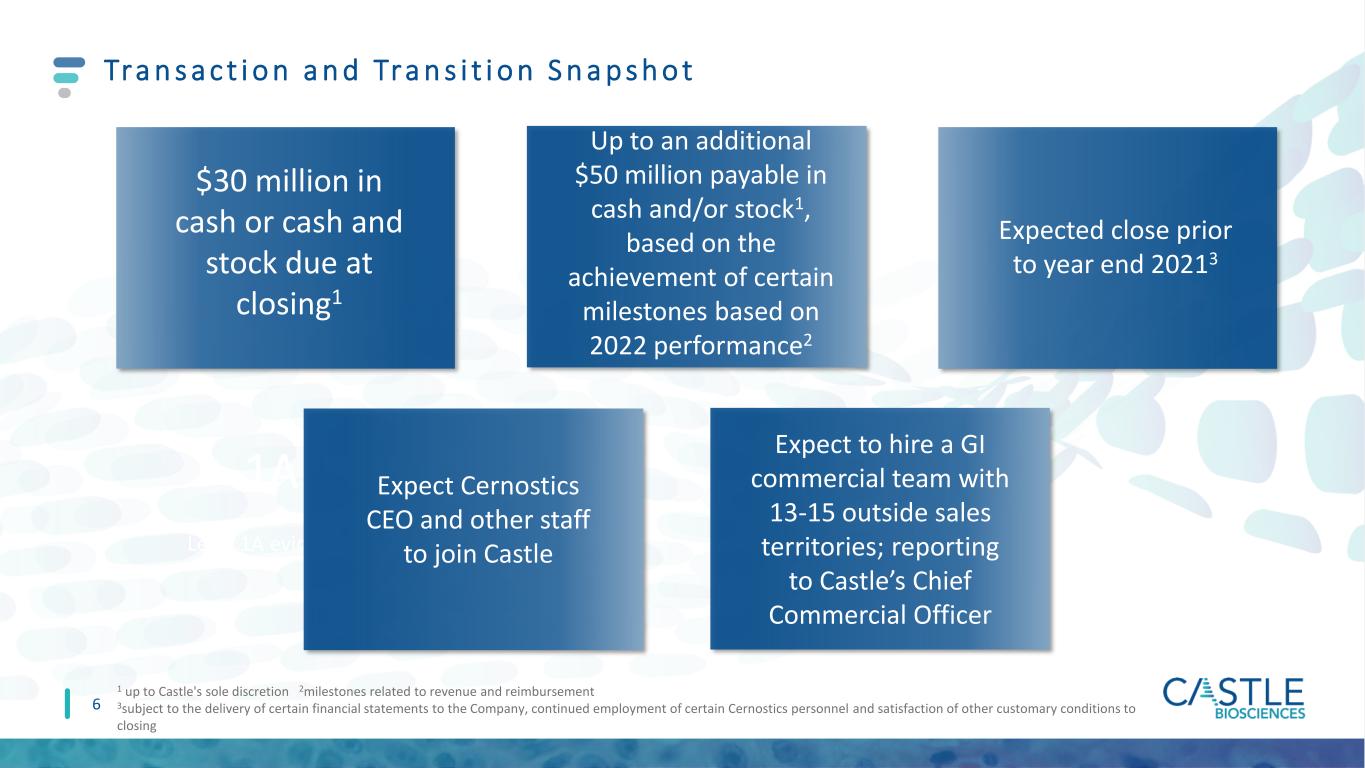
Level 1A evidence* 1A 6 Tra n s a c t i o n a n d Tra n s i t i o n S n a p s h o t Expect to hire a GI commercial team with 13-15 outside sales territories; reporting to Castle’s Chief Commercial Officer 1 up to Castle's sole discretion 2milestones related to revenue and reimbursement 3subject to the delivery of certain financial statements to the Company, continued employment of certain Cernostics personnel and satisfaction of other customary conditions to closing Expect Cernostics CEO and other staff to join Castle $30 million in cash or cash and stock due at closing1 Up to an additional $50 million payable in cash and/or stock1, based on the achievement of certain milestones based on 2022 performance2 Expected close prior to year end 20213
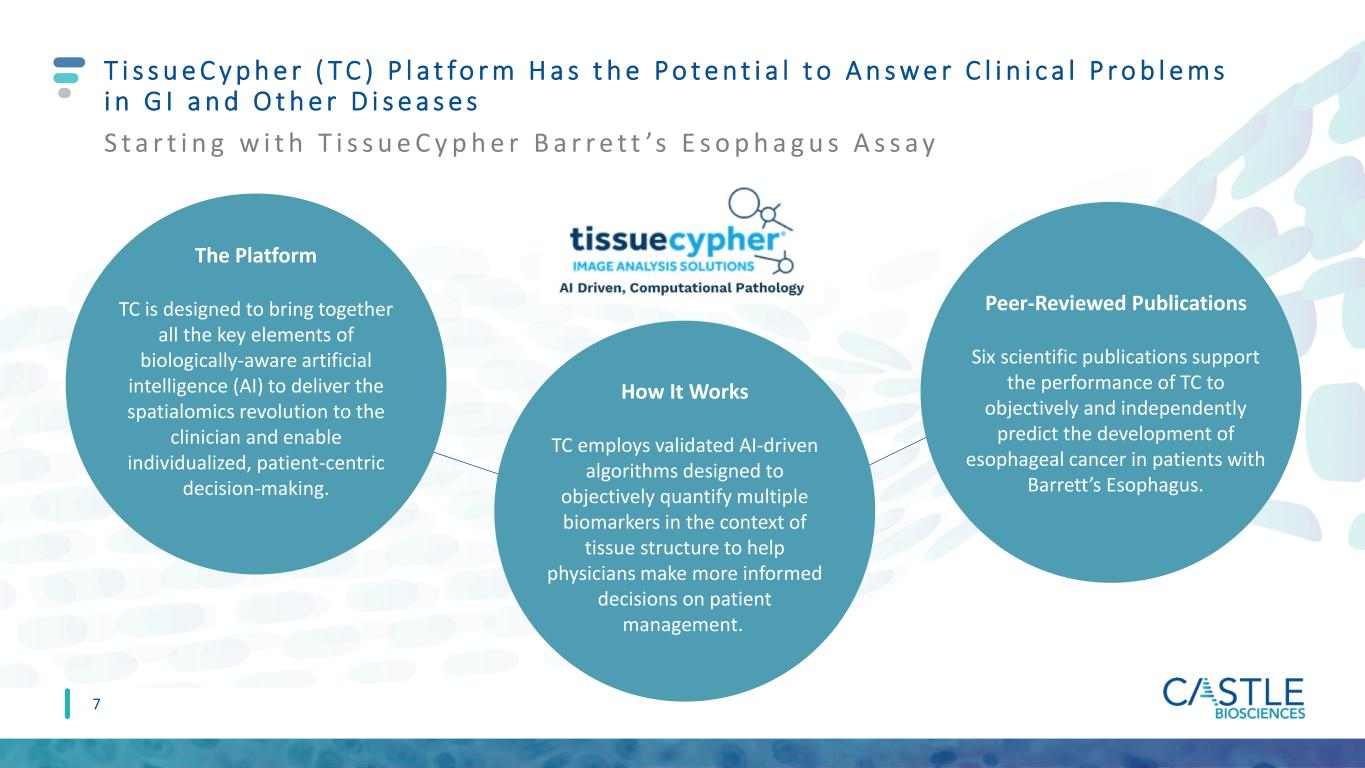
T i s s u e C y p h e r ( T C ) P l a t f o r m H a s t h e P o t e n t i a l t o A n s w e r C l i n i c a l P r o b l e m s i n G I a n d O t h e r D i s e a s e s 7 S t a r t i n g w i t h T i s s u e C y p h e r B a r r e t t ’s E s o p h a g u s A s s a y The Platform TC is designed to bring together all the key elements of biologically-aware artificial intelligence (AI) to deliver the spatialomics revolution to the clinician and enable individualized, patient-centric decision-making. How It Works TC employs validated AI-driven algorithms designed to objectively quantify multiple biomarkers in the context of tissue structure to help physicians make more informed decisions on patient management. Peer-Reviewed Publications Six scientific publications support the performance of TC to objectively and independently predict the development of esophageal cancer in patients with Barrett’s Esophagus.
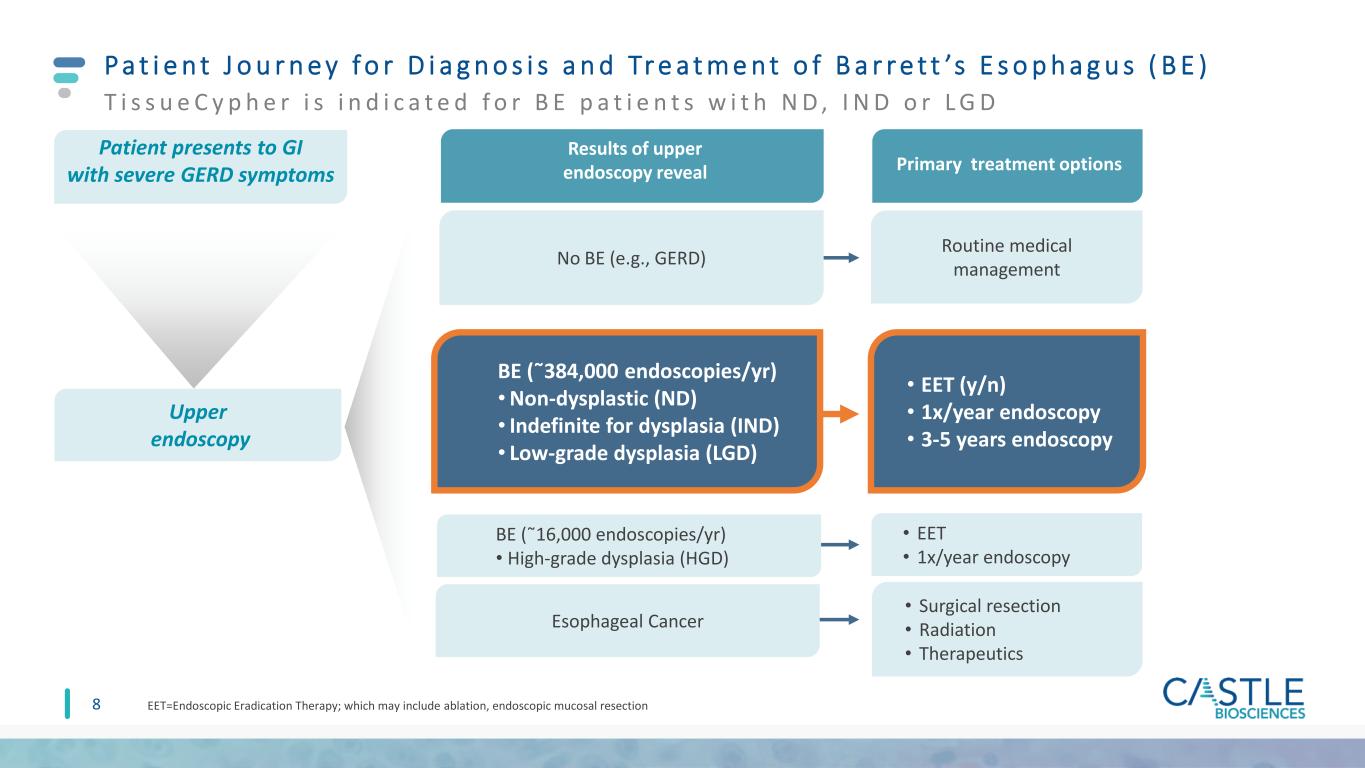
P a t i e n t J o u r n e y f o r D i a g n o s i s a n d Tr e a t m e n t o f B a r r e t t ’s E s o p h a g u s ( B E ) Esophageal Cancer No BE (e.g., GERD) Routine medical management • Surgical resection • Radiation • Therapeutics BE (῀384,000 endoscopies/yr) • Non-dysplastic (ND) • Indefinite for dysplasia (IND) • Low-grade dysplasia (LGD) • EET (y/n) • 1x/year endoscopy • 3-5 years endoscopy Primary treatment options Results of upper endoscopy reveal Upper endoscopy 8 Patient presents to GI with severe GERD symptoms T i s s u e C y p h e r i s i n d i c a t e d f o r B E p a t i e n t s w i t h N D , I N D o r L G D BE (῀16,000 endoscopies/yr) • High-grade dysplasia (HGD) • EET • 1x/year endoscopy EET=Endoscopic Eradication Therapy; which may include ablation, endoscopic mucosal resection
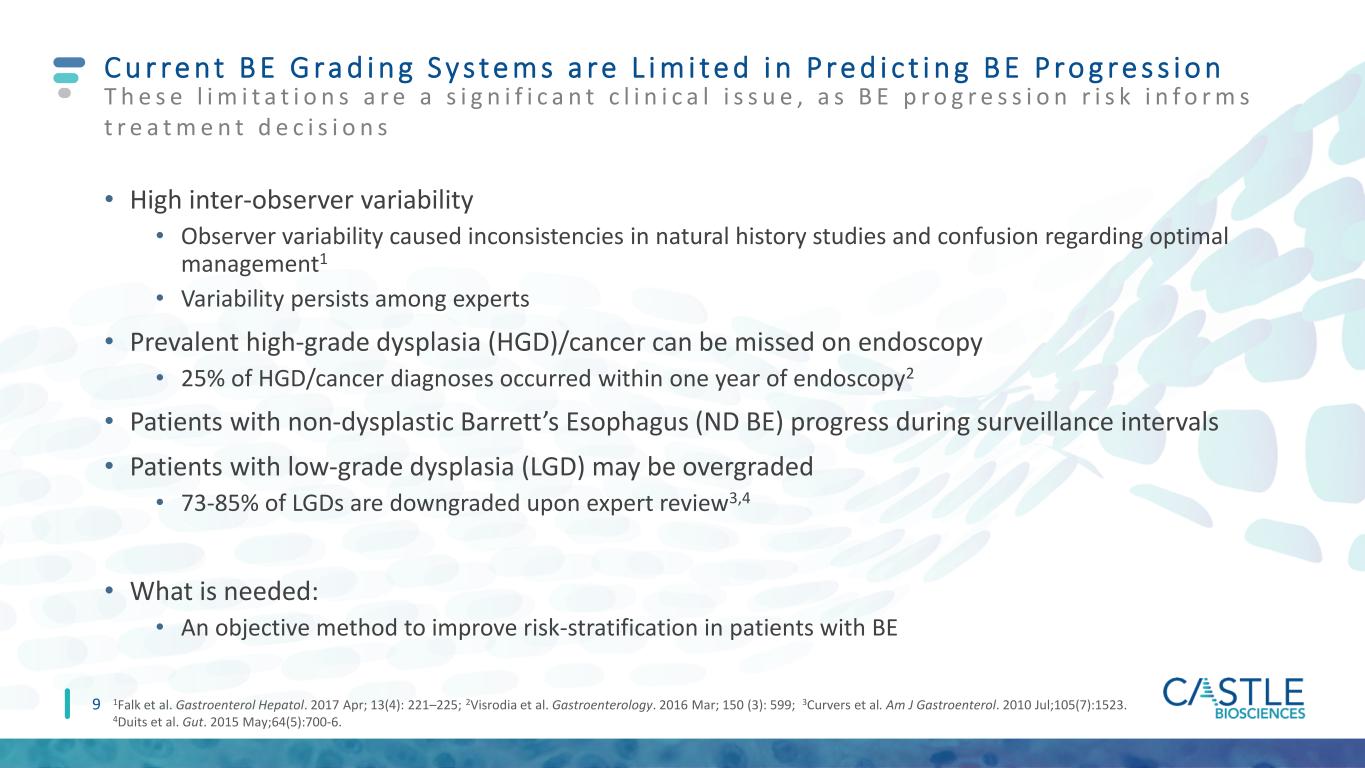
C u r re n t B E G ra d i n g S y s t e m s a r e L i m i t e d i n P r e d i c t i n g B E P ro g r e s s i o n • High inter-observer variability • Observer variability caused inconsistencies in natural history studies and confusion regarding optimal management1 • Variability persists among experts • Prevalent high-grade dysplasia (HGD)/cancer can be missed on endoscopy • 25% of HGD/cancer diagnoses occurred within one year of endoscopy2 • Patients with non-dysplastic Barrett’s Esophagus (ND BE) progress during surveillance intervals • Patients with low-grade dysplasia (LGD) may be overgraded • 73-85% of LGDs are downgraded upon expert review3,4 • What is needed: • An objective method to improve risk-stratification in patients with BE 9 1Falk et al. Gastroenterol Hepatol. 2017 Apr; 13(4): 221–225; 2Visrodia et al. Gastroenterology. 2016 Mar; 150 (3): 599; 3Curvers et al. Am J Gastroenterol. 2010 Jul;105(7):1523. 4Duits et al. Gut. 2015 May;64(5):700-6. T h e s e l i m i t a t i o n s a r e a s i g n i f i c a n t c l i n i c a l i s s u e , a s B E p r o g r e s s i o n r i s k i n f o r m s t r e a t m e n t d e c i s i o n s
T i s s u e C y p h e r I m p r o v e s R i s k - s t r a t i f i c a t i o n i n P a t i e n t s D i a g n o s e d w i t h N D, I N D o r L G D B a r r e t t ’s E s o p h a g u s 10 Non-dysplastic 348,000 endoscopies/yr Can progress to cancer Indefinite 23,000 endoscopies/yr May never progress to cancer The problem… The solution… Low-grade dysplasia 13,000 endoscopies/yr May never progress to cancer
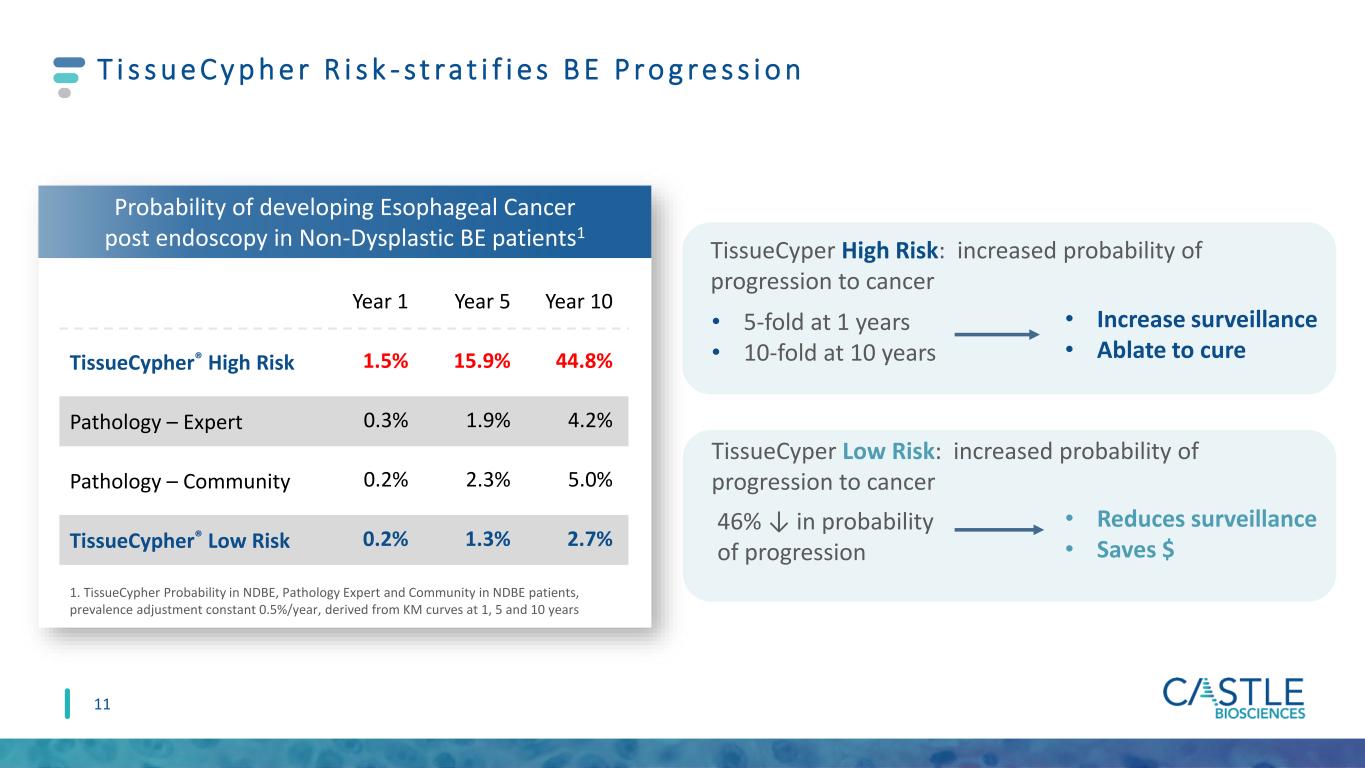
46% ↓ in probability of progression 11 1. TissueCypher Probability in NDBE, Pathology Expert and Community in NDBE patients, prevalence adjustment constant 0.5%/year, derived from KM curves at 1, 5 and 10 years Probability of developing Esophageal Cancer post endoscopy in Non-Dysplastic BE patients1 TissueCypher® High Risk Pathology – Expert Pathology – Community TissueCypher® Low Risk Year 1 1.5% 0.3% 0.2% 0.2% Year 5 15.9% 1.9% 2.3% 1.3% Year 10 44.8% 4.2% 5.0% 2.7% T i s s u e C y p h e r R i s k - s t ra t i f i e s B E P r o g r e s s i o n • 5-fold at 1 years • 10-fold at 10 years • Increase surveillance • Ablate to cure • Reduces surveillance • Saves $ TissueCyper High Risk: increased probability of progression to cancer TissueCyper Low Risk: increased probability of progression to cancer
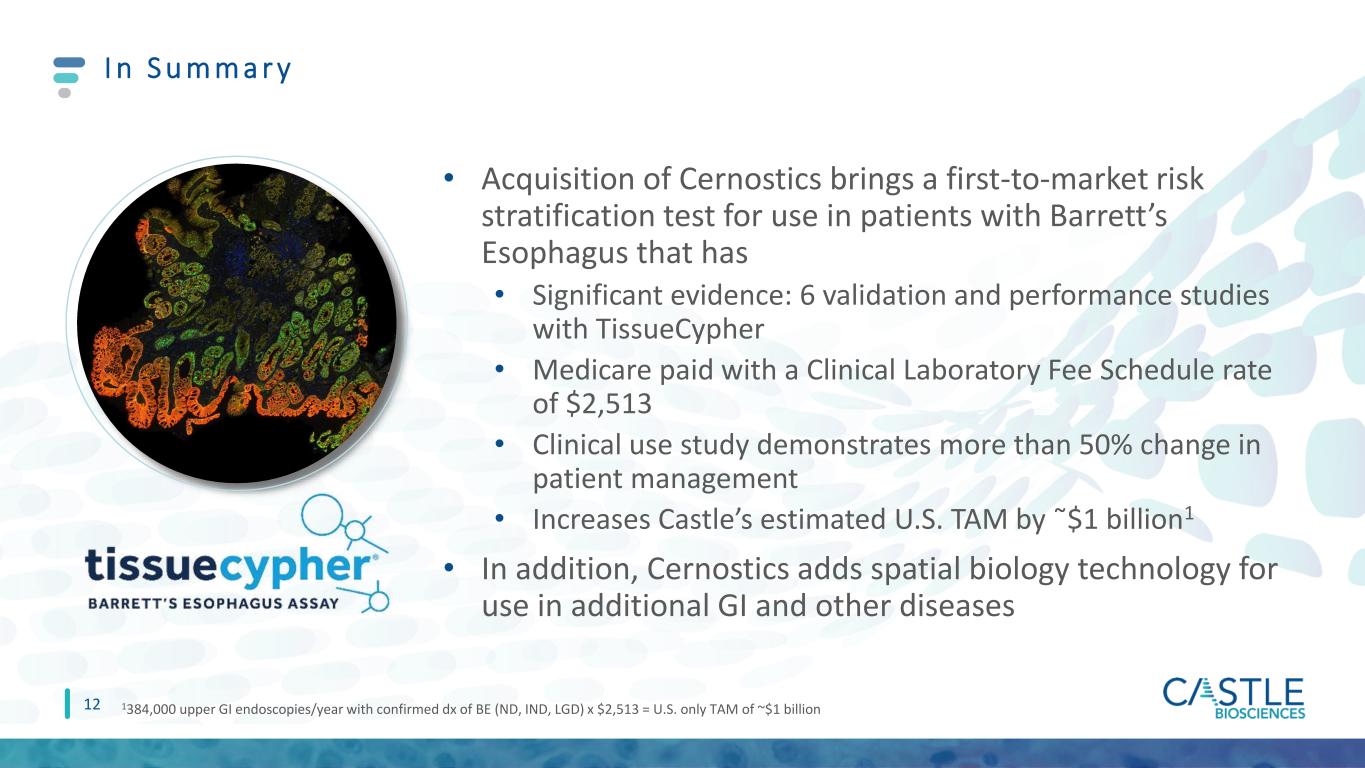
• Acquisition of Cernostics brings a first-to-market risk stratification test for use in patients with Barrett’s Esophagus that has • Significant evidence: 6 validation and performance studies with TissueCypher • Medicare paid with a Clinical Laboratory Fee Schedule rate of $2,513 • Clinical use study demonstrates more than 50% change in patient management • Increases Castle’s estimated U.S. TAM by ῀$1 billion1 • In addition, Cernostics adds spatial biology technology for use in additional GI and other diseases 12 I n S u m m a r y 1384,000 upper GI endoscopies/year with confirmed dx of BE (ND, IND, LGD) x $2,513 = U.S. only TAM of ~$1 billion

THANK YOU